Skip to content
TruckBedCoverFinder

Buyer's Guide 15 min read

Truck Bed Cover With a Tool Box: What Fits and What Length to Order

Which tonneau covers work with a truck tool box, how much bed length each box type costs you, and the cover size to order. Full compatibility matrix.

admin-truck

Editorial team · TruckBedCoverFinder
Published

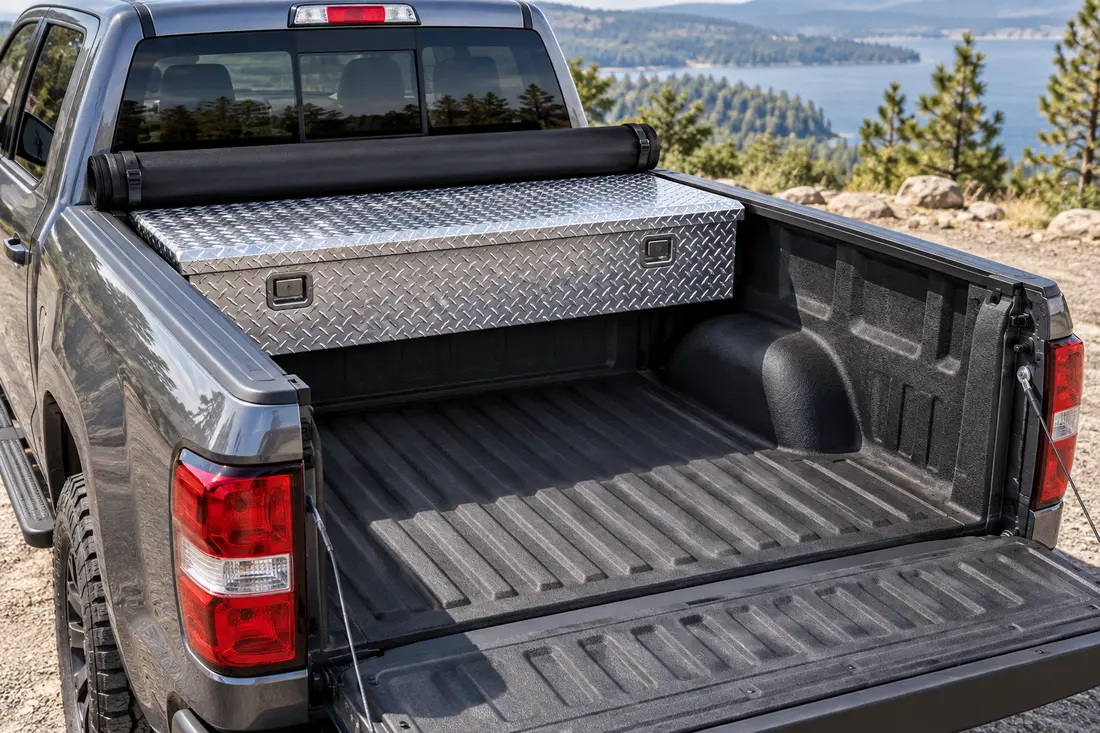
Aluminium crossover tool box in a pickup bed with a roll-up tonneau cover rolled back behind it

Almost every guide to running a tool box under a tonneau cover starts in the wrong place — with a list of covers. The question is not which cover. It is which box, where it mounts, and how many inches of bed it takes away, because those three answers decide whether you need a shortened cover, a standard one, or whether the combination is impossible on your truck.

Buyer’s Guide · 15 min read · Editorial team · TruckBedCoverFinder · Bought, not gifted · No paid placements
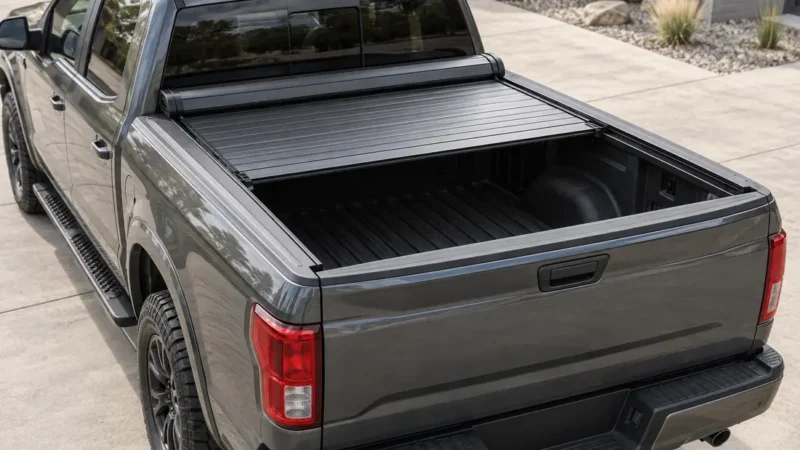
What follows is the arithmetic, the compatibility matrix by box type and cover type, and the two combinations that people buy most often and then return.

The 30-Second Answer

A crossover box plus a roll-up cover ordered in a toolbox length is the combination that works on the widest range of trucks. Roll-ups — soft or hard — are the only cover type routinely sold in shortened “toolbox” versions, so you are buying a designed solution rather than improvising one. Folding covers can work if you order to the remaining length. Retractables and hinged lids cannot share a bed with a rail-mounted box at all, and no amount of shopping changes that.

Your box What it costs you Covers that work
Crossover / saddle box 12–20 in of bed length, typically 16 Roll-up in a toolbox length; folding cut to the remainder
Low-profile crossover 12–18 in, typically 15 Same, and sometimes a cover closes over the top
Chest / trunk box No rail space — eats bed floor instead Almost any full-length cover closes over it
Side-mount / rail box No length — but occupies the rail None. This is a width conflict, not a length one
Wheel-well box No length, sits low over the arch Almost any, if the box is below rail height

Do this first: measure your box’s front-to-back footprint along the bed floor — not its width across the bed. That depth figure is the number every cover decision depends on, and it is the one people quote wrong. Then put it, with your bed length, into the toolbox and cover fit checker, which returns the remaining bed length and the cover size to order.

Why the Conflict Exists at All

A tonneau cover is not a sheet laid over the bed. It is a pair of side rails clamped to the bed rails, a front rail at the bulkhead, and panels or a roll that ride on them. Every one of those three components wants space that a tool box may already occupy.

A crossover box — the classic aluminium box that sits across the bed behind the cab — mounts on top of the bed rails. That is precisely where a cover’s front rail and the front of its side rails want to be. The two parts are competing for the same twelve to twenty inches of truck. This is why the pairing needs a purpose-made shorter cover rather than adjustment.

A chest box sits on the bed floor instead, so it never touches the rails — which is why a full-length cover usually closes straight over it. A side-mount box runs along the bed rather than across it, so it costs no length at all, but it bolts to the rail the cover needs to clamp to. Same conflict, different axis, and a much harder one to solve.

The Compatibility Matrix

Read this as: what happens to each cover type once that box is in the bed.

Cover type Crossover Low-profile crossover Chest box Side-mount Wheel-well
Soft roll-up Toolbox version Toolbox version Measure No Measure
Hard roll-up Toolbox version Toolbox version Measure No Measure
Tri-fold Measure Measure Measure No Measure
Hard folding Measure Measure Measure No Measure
Retractable No No Measure No Measure
Hinged / one-piece No Measure Measure No Measure

“Toolbox version” means the manufacturer sells a shorter cut of that cover for exactly this pairing — you order it by the remaining bed length. “Measure” means it is possible but nothing is made specifically for it: you are ordering a cover to a non-standard length and confirming clearance yourself. “No” means the design cannot work around that box, because the canister, the hinge or the lid needs the space the box is in.

The Arithmetic, by Bed Length

Take a typical crossover box at 16 inches of depth and subtract it from the common bed lengths. What is left is the cover you are shopping for.

Bed Length Left after a 16 in crossover Reality check
Compact (Maverick) 54.4 in ≈38 in Tight. A low-profile box or a chest box is the better answer.
Short bed 5.5 ft / 66 in ≈50 in Workable, and the most common toolbox-cover pairing sold.
Standard bed 6.5 ft / 78 in ≈62 in Comfortable. You still have a usable box behind the box.
Long bed 8 ft / 96 in ≈80 in Barely notice it. This is the pairing’s natural home.

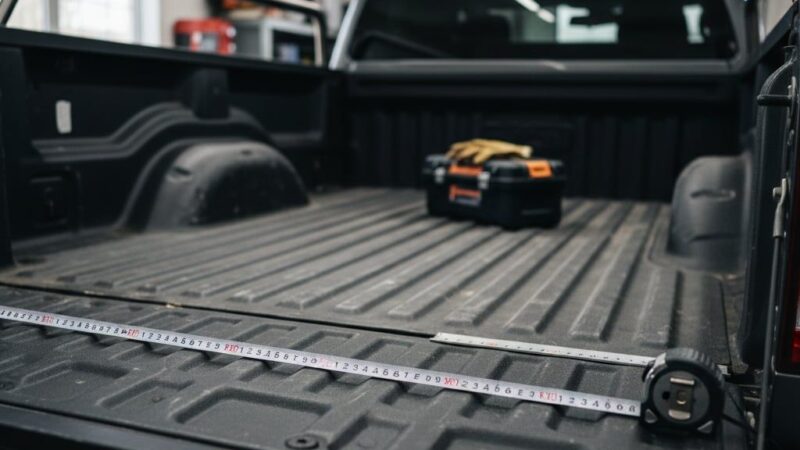
Not sure which bed you have? The bed size finder returns the exact length in inches by model and year, and the measuring guide shows the two-minute version with a tape. Measure with the tailgate closed and latched — measured open, every bed reads longer than the cover you need.

How to Measure a Box Properly

Box specifications quote width across the bed, because that is the number that sells boxes. You need the other one.

  1. Measure the footprint at the rails, not the lid. Many crossover boxes are wider at the lid than at the base. The cover’s front rail has to clear the widest point in the closed position.
  2. Measure from the bulkhead to the back face of the box, along the bed, at rail height. That is the space the box has taken.
  3. Subtract it from your bed length — tailgate closed — and add an inch of clearance. That is your target cover length.
  4. Check the height. For a low-profile box, measure from the bed floor to the top of the box and compare it with the floor-to-rail-top height. If the box is below the rail line, a cover may close straight over it and you need no shortened cover at all.

Every figure in this guide is a range because the market is a range: Weather Guard, UWS, Dee Zee, Better Built and Delta all build to their own dimensions, and two boxes that both call themselves “full-size crossover” can differ by six inches of depth. Your tape measure beats any table here, including ours.

Crossover Boxes: The Default Pairing

The crossover is the box most people mean when they say tool box: aluminium, sits across the bed on the rails behind the cab, gull-wing or single lid, hangs down into the bed. It is the most useful box for a working truck and the most awkward for a cover.

The clean solution is a roll-up cover ordered in a toolbox length. Both soft roll-ups and hard roll-ups exist in shortened versions for this exact job — the rails simply start behind the box instead of at the bulkhead. You keep the roll-back access that makes the pairing practical: the cover rolls to the back of the box, and the box lids open unobstructed.

Folding covers can be made to work, ordered to the remaining length, but you lose something. The folded stack has to live somewhere, and with a box already occupying the front of the bed, a folding cover folds backwards against the box and now you have two obstructions in a shortened bed. On a 5.5 ft bed that is a lot of truck given over to hardware.

Low-Profile Crossovers: The One Case Where Nothing Is Lost

A low-profile crossover sits low enough that a cover can often close over the top of it — the single case in this whole guide where you may not need a shortened cover at all. The box is in the bed, the cover is full length, both work, nothing is given up but the floor space under the box.

The word doing the work is “often”. The lid still has to clear the underside of the closed cover, and folding covers in particular sit lower over the bed than you would expect. Measure the height from bed floor to rail top, measure the box, and leave an inch. If it clears, this is the best answer in the guide.

Chest Boxes: The Escape Hatch

A chest or trunk box sits on the bed floor rather than on the rails. Because it never touches the rail line, a full-length cover of almost any type — including a retractable — closes right over it. Nothing has to be shortened, nothing has to be ordered special.

The trade is real: the box eats bed floor, and the space above it, under the closed cover, is now unusable for anything but flat items. You have swapped length for volume. On a long bed that is a good trade. On a compact bed it can take most of what you had.

If you want to see what volume is left, the bed volume calculator converts your remaining bed dimensions into cubic feet and yards, which is the honest way to compare a chest box against a crossover before you buy either.

Side-Mount Boxes: Pick One

A side-mount or rail box runs along the bed rather than across it. It costs no bed length whatsoever, which sounds ideal, and it bolts to exactly the rail a tonneau cover’s side rails need to clamp to.

There is no clean way around this. The cover cannot clamp where the box is, and the box cannot move without losing the mounting that holds it. Across all six cover types this is the one combination our compatibility data returns as flatly incompatible. If you own a side-mount box and want a cover, you are choosing between them — or moving to a wheel-well box, which does the same job in the same part of the bed without touching the rail.

Wheel-Well Boxes: The Quiet Winner

A wheel-well box sits low over the wheel arch, costs no bed length, and clears almost every cover — provided it is below rail height. For a truck that needs secure storage for tools and a cover for everything else, this is frequently the best-engineered answer available, and it is the one most people never consider because it is not what the word “tool box” brings to mind.

Measure it anyway. A taller wheel-well box fouls a folding cover’s panels exactly where they stack, which is a failure you discover after installation rather than before.

Truck-Specific Notes

The box-and-cover question changes shape depending on what you drive, because bed rail design is not standard across the market.

  • Ford F-150 — the most accommodating truck here. Deep bed rails, the widest selection of toolbox-length covers, and a factory rail system on many trims that a box and a cover can both work around. Check your setup in the F-150 fitment checker, and see the cover shortlist in our F-150 cover guide.
  • Ram 1500 with RamBox — the truck where this question gets genuinely complicated. RamBox builds lockable storage into the bed rails themselves, which changes both the rail profile a cover clamps to and whether you need a crossover box at all. Covers exist specifically for RamBox beds; standard Ram covers do not fit them. Details in the Ram 1500 guide.
  • Chevy Silverado and GMC Sierra — GM’s bed rail design takes specific clamps, and the multi-function tailgate on some trims adds a second clearance question behind the cover. Run it through the fitment checker for your year.
  • Mid-size trucks — Tacoma, Ranger, Colorado, Frontier — a full-size crossover box in a 5 ft bed leaves very little. Look hard at low-profile and wheel-well boxes here before committing to a crossover.
  • Compact — Maverick, Santa Cruz — a 16 in box in a 54 in bed leaves about 38 inches. Workable for a commuter with a small box, not for a working truck. Our Maverick cover guide works this case through in detail.

What It All Weighs

Nobody budgets for this and everybody feels it. An empty full-size aluminium crossover box is 60–90 lb. Fill it with hand tools, a compressor and recovery gear and you are at 150–250 lb before anything else goes in the bed. A hard cover adds another 50–75 lb. That is up to a third of a ton of accessories on a mid-size truck with a payload rating around 1,600 lb.

It comes off your payload, not your towing capacity, and it is there permanently — every trip, loaded or not. Before you buy the box, run the real figure through the payload calculator, which subtracts passengers, accessories and the cover itself from your truck’s actual rating. If you tow, the same weight also shifts your tongue weight percentage, and the tongue weight calculator shows what that does to the safe range.

Security: The Box, the Cover and the Tailgate

A locked box under a locked cover is genuinely secure storage, and the pairing is the reason most people build it. But a tonneau cover locks to the tailgate, and if the tailgate does not lock, lowering it takes the cover out of the way along with it.

Test yours: lock the truck, then try the tailgate. If it opens, add a lock before you add anything else. A manual tailgate lock is the cheap version, the powered one ties into central locking, and the BOLT lock codes itself to your ignition key so the truck takes one key rather than two.

With all three — box, cover, tailgate lock — a bed stops being opportunist territory. With any one missing, the other two are doing less than the receipt suggests.

Install Order and Clearances

  1. Box first, cover second. Always. The cover is ordered to what is left, and you cannot know what is left until the box is bolted down.
  2. Leave an inch behind the box. Cover rails need somewhere to start, and a rail butted hard against a box transmits every bump as a rattle.
  3. Check the lids in the open position. Gull-wing lids swing outward and upward; make sure they clear the front rail of the cover, not just the closed cover.
  4. Keep the drain path clear. If your cover has drain tubes at the bulkhead, a box mounted over them redirects water into the bed rather than out of it.
  5. Re-torque after a week. Both the box and the cover clamps. This pairing carries more weight and more leverage than a bare cover, and everything settles.

If the Combination Does Not Work on Your Truck

  • Under-bed swing cases mount outside the bed entirely, take no bed length and no rail space, and leave you free to fit any cover you like. Less capacity than a crossover, zero conflict.
  • In-bed drawer systems live under a full-length cover and turn the whole bed into lockable storage. Expensive, heavy, and superb if the truck is a working vehicle.
  • A chest box plus a full-length cover, per above, if you can spare the floor rather than the length.
  • A cover with no box at all, plus a locking bed divider, if what you actually needed was for the tools to stop sliding around.

Still weighing cover types rather than boxes? The cover type quiz takes six questions, and the full cover types guide explains what each one is good at before a box enters the picture.

Tonneau Cover With a Tool Box — FAQ

Can you use a tonneau cover with a tool box?

Yes, in most combinations. A crossover box needs a cover ordered in a shortened “toolbox” length, most commonly a soft or hard roll-up. A chest or wheel-well box usually sits under a standard full-length cover. A side-mount box is the exception — it occupies the rail the cover clamps to, and the two cannot coexist.

What size tonneau cover do I need with a tool box?

Bed length minus the box’s front-to-back depth, plus about an inch of clearance. A 16-inch crossover box in a 6.5 ft (78 in) bed leaves roughly 62 inches to cover. Work it out for your exact truck and box in the toolbox cover fit checker.

Will a tonneau cover close over a tool box?

Over a chest box or a wheel-well box, usually yes. Over a low-profile crossover, sometimes — measure from the bed floor to the top of the box and compare it with the rail height. Over a full-height crossover, no: you need a shortened cover that starts behind it.

Can you fit a retractable cover with a tool box?

Not with any rail-mounted box. The retractable’s canister needs the space at the bulkhead that a crossover box occupies, and retractables are not sold in shortened lengths for this. With a chest box or a wheel-well box on the bed floor, a retractable closes over the top like any other full-length cover.

Does a tool box under a cover affect fuel economy?

Barely. Once a closed cover is over the bed, the air does not know what is underneath it. The weight is what costs you — a loaded crossover box is easily 150 lb, and that comes off your payload. Check what you have left in the payload calculator.

Which cover type is best with a tool box?

A hard roll-up, if you want security and a sealed bed: it is sold in toolbox lengths and it rolls back to the box rather than folding into the remaining space. A soft roll-up if cost matters more than security. Hard folding is workable but gives up more of a shortened bed than people expect.

Start With Your Own Numbers

Put your bed length and box type into the tonneau cover with toolbox checker — it returns the remaining bed length, the cover size to order and which cover types can share the bed with your box. Then confirm the fit for your specific truck in the fitment checker, and browse what is available by type in the cover database.

Keep reading

Related stories

Find my cover