Skip to content
TruckBedCoverFinder

Buyer's Guide 10 min read

DiamondBack Truck Bed Covers: Who They Are Really For

DiamondBack builds an aluminium load deck, not a lid. Here is the line-up, the payload arithmetic nobody does first, and the honest test for whether you need one.

admin-truck

Editorial team · TruckBedCoverFinder

Published

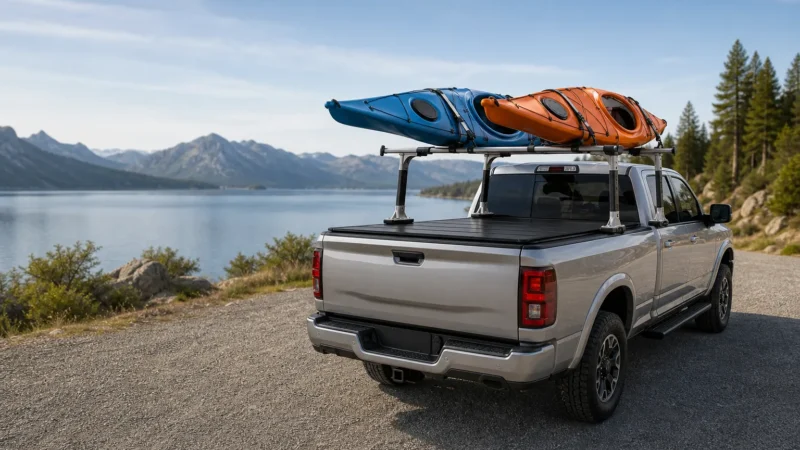
White heavy-duty pickup with an aluminium diamond-plate hard bed cover carrying a kayak on a roof-rack crossbar system

DiamondBack does not make a tonneau cover. It makes an aluminium deck that happens to close over a truck bed, and that distinction explains everything about the brand: the weight, the price, the fanatical owners, and the people who buy one and regret it within a month.

Brand Review · 17 min read · Editorial team · TruckBedCoverFinder · Bought, not gifted · No paid placements

If you are here because you saw one on a job site or an overland build and wondered whether it is worth three times what a BAKFlip costs, this is the honest version. What the line-up actually is, who it genuinely suits, and the four questions that decide it before you look at a single price.

The 30-Second Answer: TL;DR

A DiamondBack truck bed cover is a heavy-gauge aluminium hard cover built to be stood on, loaded on and racked on. Buy one if you carry loads above the bed as routinely as inside it — a rooftop tent, kayaks, lumber, a bike rack, ladders — and you want a locked, sealed bed underneath at the same time. Skip it if you mostly want a lid: you will pay a large premium and add serious weight for capability you never use.

If you are… Then…
Building an overland rig with a rooftop tent or racks DiamondBack is one of a very short list that makes sense
A contractor hauling ladders and pipe above a locked bed Strong case — this is the brand’s home turf
Wanting security and weather for tools inside the bed A sealed hard folder does it for far less money
Chasing a clean look and easy removal Wrong brand entirely — look at folding or retractable
Worried about payload on a mid-size truck Weigh the cover against your remaining payload first

The honest part: most people who ask about DiamondBack want the look — the diamond-plate deck, the professional-tool aesthetic. That is a legitimate reason to want something, but it is an expensive way to buy an appearance. If nothing is ever going on top of the cover, you are paying for structure that does nothing but add weight to your truck.

Bought, not gifted. No paid placements. At no extra cost to you.

What DiamondBack Actually Builds

DiamondBack Truck Covers builds in Philipsburg, Pennsylvania, and sells direct rather than through the big online retailers. That single fact shapes the whole ownership experience. You will not find these on Amazon next to a Tyger tri-fold, you configure the cover on the maker’s site for your exact truck, and it is built to that order rather than pulled off a shelf.

The construction is the other half. Where a mainstream hard folding cover is a sandwich panel designed to keep weather out and resist a pry bar, a DiamondBack is a structural aluminium deck — heavy plate, deep sections, hardware sized for load rather than for weight savings. The covers carry load ratings that fold-out covers do not approach, which is exactly why racks and roof tents get bolted to them.

Two consequences follow, and both matter more than any spec:

  • Weight. These are among the heaviest covers on the market — enough that removing one is a two-person job with a plan, not a Saturday whim. On a half-ton it is a payload line item. On a mid-size truck with a modest payload rating, do the arithmetic before you order.
  • Permanence. A DiamondBack is a decision about what your truck is. Owners keep them on for years. If your bed configuration changes seasonally, this is the wrong architecture.

The Line-Up, and Which One You Actually Want

The catalogue looks larger than the decision really is. Strip the finishes and options away and there are three genuinely different products.

DiamondBack HD — the load-carrying default

The core product and the reason the brand exists. A full aluminium deck with the classic diamond-plate surface, built to take weight on top and hinge open in sections for bed access. This is the one to configure if the phrase “I want to put things on top of my cover” is anywhere in your thinking.

What you gain over a premium folding cover is not marginal — it is a different capability class. What you give up is weight, price, and the ability to strip the bed bare in five minutes.

DiamondBack 270 — access without unloading the roof

The clever one. It opens across a much wider arc than a conventional hinged panel, which means you can reach into the bed without first pulling the gear off the top. If you have a rack loaded with kayaks or a tent on the front section, the 270 is what stops the cover being a daily annoyance.

It costs more than the HD and adds mechanism, which is the eternal trade. Worth it specifically when the load on top is semi-permanent and the bed underneath is in constant use. Overlanders and tradespeople land here for the same reason from opposite directions.

DiamondBack SE and the smooth-finish options — the same deck, different face

The diamond-plate look is polarising, and the smooth-panel variants exist for people who want the structure without the toolbox aesthetic. Mechanically you are buying the same idea. Choose on appearance and on how the finish will wear where you will actually stand on it — plate hides scuffs, smooth shows them.

Configure in this order: truck and bed length first, then the model, then the finish, then accessories. Getting the bed length wrong is the only mistake in this category that cannot be fixed after the fact — our bed measuring guide takes five minutes and the Bed Size Finder will confirm it from your truck’s trim.

Who Should Actually Buy One

We put this brand in front of four kinds of owner and only three of them stayed happy.

The overland build

A rooftop tent, a solar panel, traction boards, a fuel can — all mounted above a bed that stays locked and dry underneath. Nothing in the folding or retractable world does this. If your build sheet includes a rack, DiamondBack belongs on the shortlist next to a purpose-built bed rack system.

The working truck

Ladders, conduit and lumber on top; tools locked below. Contractors who have run one tend to describe it in terms of what stopped happening — no more strapping to open stake pockets, no more soaked drills. The weight penalty is real but a work truck is usually specced with the payload to absorb it.

The recreational hauler

Bikes, kayaks, ski boxes. Strong case, with one caveat: if the gear only comes out four months a year, ask honestly whether a cheaper cover plus a proper tonneau-and-rack combination gets you there for less.

The owner who just wants a nice lid — the one who regrets it

If the cover’s job is to keep rain off groceries and hide a toolbox, a sealed hard folding cover does that job as well as anything DiamondBack builds, weighs a third as much, comes off in minutes and costs a fraction. Our hard folding picks are the honest alternative, and we would rather send you there than watch you pay for structure you will never load.

DiamondBack vs. the Covers People Cross-Shop

DiamondBack Premium hard folding Retractable
Load on top Designed for it Light loads only Rails on some models
Weight Heaviest class Moderate Moderate to heavy
Full bed access Sectional, cover stays on Folds forward, or remove Rolls back, canister stays
Weather sealing Excellent Very good on good models Excellent
Where you buy Direct from the maker Everywhere Everywhere
Removal Two people, planned One person, minutes Canister is semi-permanent

Prices move constantly and vary by truck, so we do not print them — but the ranking does not move: DiamondBack sits well above the premium folding tier, which sits above mainstream soft covers. If the load-on-top capability is not in your use case, you are buying the top of that ladder for the view.

Cross-shopping the categories rather than the badges? Start with cover types matched to how you use your truck, and if you are torn between the two premium answers, retractable vs. folding settles most of it.

Living With One: Weight, Payload and the Things Nobody Mentions

Payload arithmetic, done once

Your door-jamb sticker gives the payload for your exact truck. Subtract the cover, then the rack, then the tent, then the gear, then the people. Half-ton owners usually have room. Mid-size owners often discover the tent alone eats what is left. This is a ten-minute check with our payload calculator and it prevents the single most expensive mistake in the overland-build sequence.

Fuel economy

A heavy cover plus a loaded rack costs you mpg, and it is not the cover’s aerodynamics doing the damage — it is the mass and the gear above the cab line. Anyone quoting you a fuel saving from a cover this heavy is quoting a brochure; the realistic picture is in are tonneau covers worth it.

Water

Sealed hard covers keep cargo dry, and this class is at the good end of that. The rules do not change with price: check the perimeter seal, keep the drains clear, and do not aim a pressure washer into a seam. Full detail in our guide to what actually stays dry.

Buying direct

No Amazon listing means no Prime-speed shipping and no one-click return. It also means the cover is built for your truck and you talk to the people who made it. Freight for something this large and heavy is its own line item — confirm it before you commit, along with the current warranty terms, which we deliberately do not quote here because they change.

The Questions Buyers Actually Ask

Can you stand on a DiamondBack cover?

Standing on it is the ordinary case, not the stunt — that is the entire design premise. Load ratings vary by model and by how the weight is distributed, so confirm the current figure for your configuration with the maker rather than trusting a forum post from four years ago.

Is a DiamondBack worth the money?

If you load the top: yes, and there is not much competition. If you do not: no, and it is not close. That is the whole answer, and any review that gives you a different one is not asking what you carry.

Can you put a rooftop tent on one?

This is one of the main reasons people buy the brand. The limits are the cover’s rating and — more often the real constraint — your truck’s payload with everything else added. Do the payload maths before the aesthetics.

Does it come off easily?

No. Plan on two people and a place to store a large, heavy panel. If you need a bare bed regularly, buy a cover designed to leave, not a deck designed to stay.

DiamondBack or BAKFlip?

Different questions. BAKFlip is the answer to “I want a secure, sealed, convenient lid” — see our BAKFlip line-up guide. DiamondBack is the answer to “my cover is also a load floor.” Owners who cross-shop them on price alone almost always want the BAKFlip.

Where do you buy one?

Direct from DiamondBack. Configure for your truck, bed length and finish. Confirm freight and lead time up front, because both are longer than the retail-shelf experience you may be used to.

The Bottom Line

DiamondBack builds the best answer to a narrow question: how do I carry weight on top of my bed while keeping the bed itself locked and dry? For overland builds, working trucks and serious gear haulers, it is worth the premium and the pounds. For everyone else it is a beautifully made solution to a problem they do not have — and a sealed hard folding cover will make them happier for a third of the money.

Next: narrow by your truck in covers by truck model, compare the whole field in the product database, or see how the other direct-sell specialists compare in our Peragon review and WeatherTech review.

Keep reading

Related stories

Find my cover