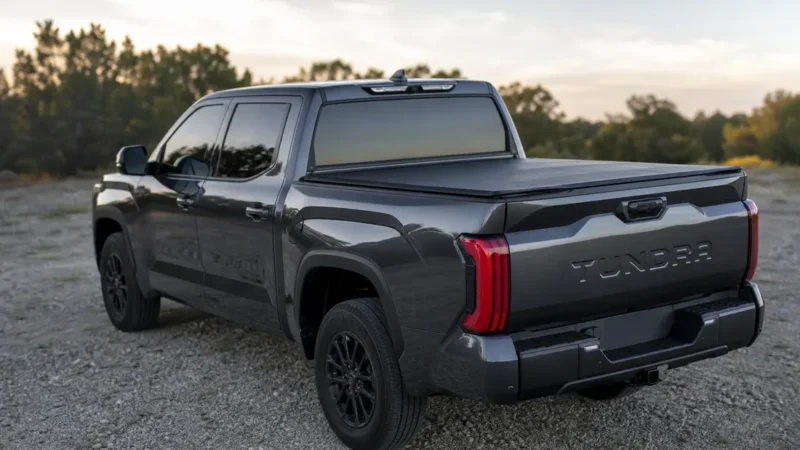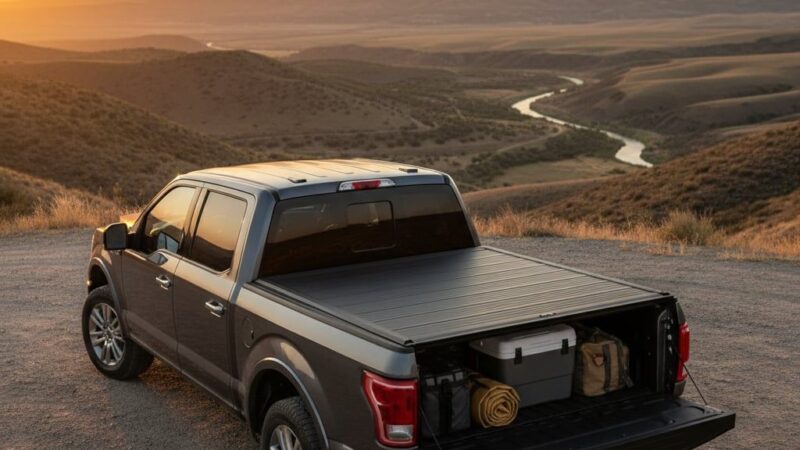
Ford · Heavy-duty pickup (3/4-ton)
Ford F-250 Super Duty towing capacity & payload by year
Maximum towing and payload for every F-250 Super Duty generation from 2005–2026, with the engines behind each rating — and what is really left once the truck is loaded.
2023–present · 5th gen Super Duty
23,000 lb
maximum towing, properly equipped
What's left after passengers and cargo → F-250 Super Duty bed sizes & specs →
Manufacturer maximum for a best-case configuration. Cab, bed, drivetrain, axle ratio and options all move the real number, usually downward. Your truck's own limits are on the door-jamb sticker and in the owner's manual.
F-250 Super Duty towing & payload, generation by generation
| Years | Generation | Max towing | Max payload | Engines |
|---|---|---|---|---|
| 2023–present | 5th gen Super Duty | 23,000 lb | 4,260 lb | 6.8L V8 (gas, standard) (405 hp) · 7.3L Godzilla OHV V8 (gas) (430 hp) · 6.7L Power Stroke turbo-diesel V8 (standard output) (475 hp) · 6.7L Power Stroke High-Output turbo-diesel V8 (500 hp) |
| 2017–2022 | 4th gen facelift / aluminum body | 20,000 lb | 4,200 lb | 6.2L Boss SOHC V8 (gas) (385 hp) · 7.3L Godzilla OHV V8 (gas, added 2020) (430 hp) · 6.7L Power Stroke turbo-diesel V8 (2017-2019) (440 hp) · 6.7L Power Stroke turbo-diesel V8 (2020-2022) (475 hp) |
| 2011–2016 | 4th gen Super Duty | 19,600 lb | 4,290 lb | 6.2L Boss SOHC V8 (gas) (385 hp) · 6.7L Power Stroke turbo-diesel V8 (2011-2014) (400 hp) · 6.7L Power Stroke turbo-diesel V8 (2015-2016) (440 hp) |
| 2008–2010 | 3rd gen Super Duty | 16,100 lb | 4,920 lb | 5.4L Triton SOHC V8 (3V) (300 hp) · 6.8L Triton SOHC V10 (3V) (362 hp) · 6.4L Power Stroke twin-turbo diesel V8 (350 hp) |
| 2005–2007 | 2nd gen Super Duty | 15,000 lb | 5,800 lb | 5.4L Triton SOHC V8 (3V) (300 hp) · 6.8L Triton SOHC V10 (3V) (362 hp) · 6.0L Power Stroke turbo-diesel V8 (325 hp) |
Ratings from before the mid-2010s were set by each manufacturer's own method. The industry-wide SAE J2807 standard adopted since then is stricter, so a modern figure and an older one are not strictly comparable even on the same model.
Trucks that tow about the same
The closest models on record by maximum towing — the natural cross-shop if the rating is what you are buying on.
F-250 Super Duty towing — frequently asked
How much can a Ford F-250 Super Duty tow?
The current Ford F-250 Super Duty (2023–present) is rated up to 23,000 lb. That is the maximum for one specific configuration — usually the lighter cab and bed with the tow package and the right axle ratio. A loaded crew-cab four-by-four of the same year will be meaningfully below it, and the number on your door-jamb sticker is the one that counts.
What is the payload capacity of a Ford F-250 Super Duty?
Up to 5,800 lb across the generations on this page. Payload covers everything the truck carries rather than pulls: passengers, everything in the cab and the bed, a tonneau cover, and the tongue weight the trailer puts on the hitch. That last one is why trucks so often run out of payload while still well inside their towing rating — a 7,000 lb trailer at 12 per cent tongue weight puts 840 lb into the bed before you have loaded anything.
Has the F-250 Super Duty's towing capacity changed over the years?
Yes — across 2005–2026 the maximum rating has risen, from 15,000 lb on the oldest generation on record to 23,000 lb on the current one. Comparing across generations is not quite like for like, though: the SAE J2807 tow-rating standard was adopted industry-wide in the mid-2010s, and it produced lower, more honest numbers than the in-house methods that came before it.
Does a tonneau cover reduce what my F-250 Super Duty can carry?
It comes out of payload, not towing capacity. A hard folding or retractable cover typically weighs 50 to 80 lb, and that sits in the same budget as passengers, cargo and tongue weight. On a crew cab already close to its payload limit, it is worth counting — on a truck with plenty of margin, it is noise.
What should I actually plan to tow with a F-250 Super Duty?
Take the rating that applies to your exact truck from the door-jamb sticker, then plan to stay under roughly 80 per cent of it. That margin is what absorbs grades, headwinds, altitude and the fact that a trailer's real loaded weight is always higher than its dry weight. Then check payload separately, because that is usually the limit you hit first.