Skip to content
TruckBedCoverFinder

Uncategorized 18 min read

How to Clean a Tonneau Cover Without Wrecking It

admin-truck

Editorial team · TruckBedCoverFinder

Published · Updated

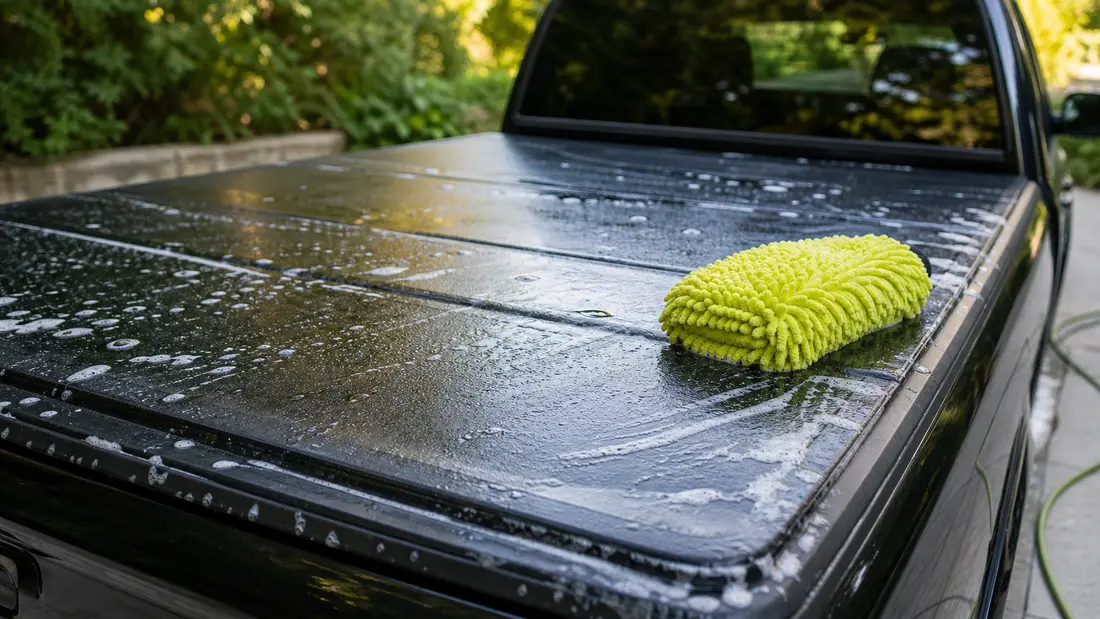
Washing a black vinyl tonneau cover with soapy water and a microfiber wash mitt

The answer depends on what your cover is made of. Vinyl, canvas, aluminum, and fiberglass each have different rules, and the wrong cleaner can void your warranty.

How-To Guide · 15 min read · Editorial team · TruckBedCoverFinder

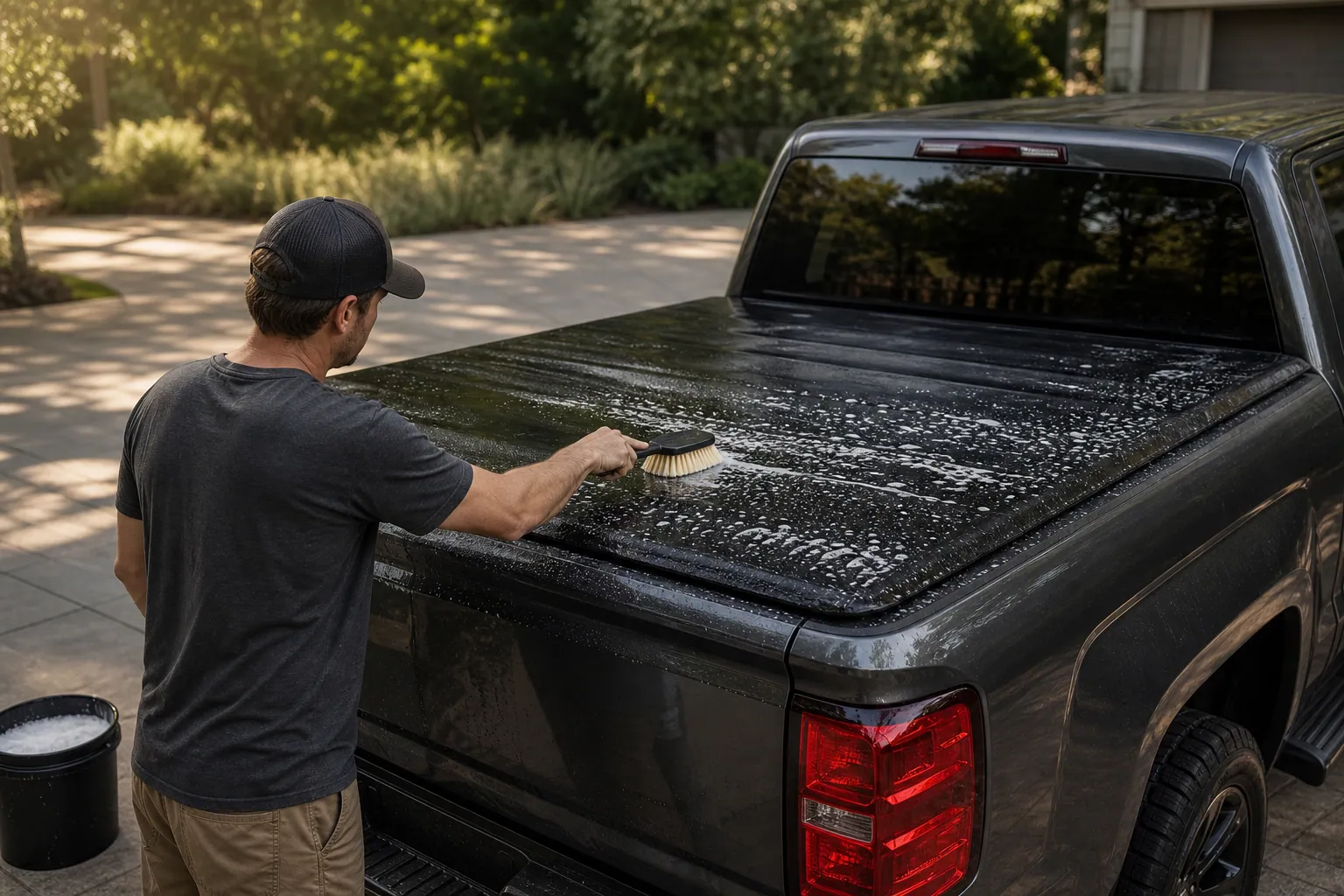
Truck owner washing a soft vinyl tonneau cover with a soft brush in a shaded driveway

Most people clean a tonneau cover the same way they clean the truck: same shampoo, same mitt, maybe a shot of Armor All to make the vinyl look new. On a hard aluminum cover that mostly works. On a soft vinyl one it slowly strips the factory coating, and on more than a few covers it voids the warranty outright.

We install and test these covers ourselves, and the failures we see are almost never from age. They are from the wrong product or from folding the cover up wet. So the honest version of this guide is short: figure out your material first, keep one list of banned products in your head, and follow a few steps that take 15 to 20 minutes.

This is a maintenance job, not a detailing project. Done monthly it adds years. Skipped, it is the fastest way to make a good cover look tired. If you are still deciding whether the upkeep is worth it, it usually is, and here is why it is worth maintaining a tonneau cover.

The 30-Second Answer

  • Soft covers (vinyl, canvas): mild pH-neutral soap and a soft brush. No Armor All, no petroleum, no silicone sprays.
  • Hard covers (aluminum, fiberglass): standard car shampoo is fine. Keep wax off the rubber seals.
  • Dry it completely before rolling or folding. Trapped moisture starts mold growth within 24 to 48 hours (EPA).
  • Pressure washer: keep it under 1,200 psi, fan nozzle, stand back 18 inches or more. A garden hose is the safer first choice.
  • Car washes: touch-free only, and decline the spray-wax add-on every time.
  • UV protectant: every 30 to 45 days in hot climates, every 3 months in mild ones.

1. Know Your Cover Type First (The 30-Second Decision Gate)

Before you touch a single product, identify your cover. The material decides every cleaner, brush, and protectant choice below. Soft covers are sensitive and have their own banned list. Hard covers behave like your truck's paint. Retractable covers add a rail and track that is the part most likely to fail. Get this wrong and the right cleaner becomes the wrong one.

This is the step every competitor buries inside the article. We put it first because the most common cleaning damage we see starts here, with someone reaching for a product that is fine on their material but ruinous on yours.

Soft covers (vinyl roll-up, canvas tri-fold)

The most sensitive category. The top surface is coated vinyl or canvas stretched over a frame, and that factory coating is what gives UV and water resistance. Almost everything on the "skip entirely" list further down exists because of soft covers. If you have a roll-up or a fabric-topped tri-fold, treat it like the delicate one in the lineup.

Hard covers (aluminum folding, fiberglass, ABS)

These are close to paint care. A matte aluminum folding cover, a painted fiberglass one-piece, or an ABS panel can take normal car shampoo and a wash mitt. The two differences from washing the truck: keep wax away from the rubber seals, and use dry lube on the hinges. LINE-X notes that its hard covers handle a normal snow load without structural issues, and its LXP and Eclipse models are rated dent-resistant under hail, so the panel itself is rarely the worry. The seals and hinges are.

Retractable covers (aluminum or polycarbonate slats on aluminum rails)

A retractable cover rolls into a canister on slats that ride in side rails. Per LINE-X, these can support over 500 lbs, but that strength means nothing if the track jams. The slats clean like a hard cover. The rails are the critical part, and they want dry lubricant, never oil. More on why oil is the wrong call in the hard-cover section.

One extra note on retractables: rinse the rails out before you lube them. The channel collects sand, salt, and grit that a quick top-wash never reaches, and lubricating over that grit just packs it in. A low-pressure hose run down each rail, then a full dry, then dry lube, is the order that keeps the slats rolling smoothly.

Not sure which bucket you are in? Our explainer on hard vs soft tonneau cover walks the differences, and the breakdown of types of tonneau covers covers the full set.

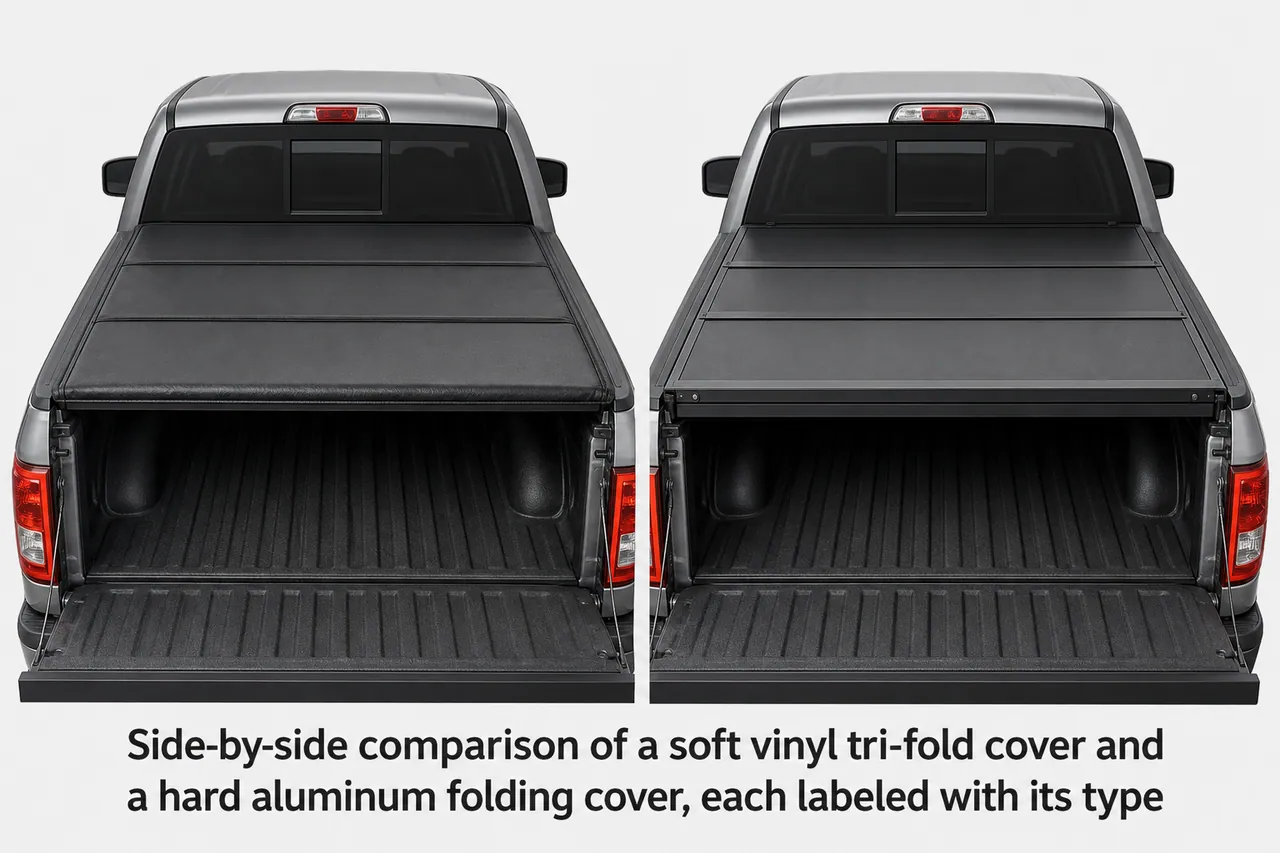
Side-by-side comparison of a soft vinyl tri-fold cover and a hard aluminum folding cover, each labeled with its type


2. What You Need (Supplies Checklist)

Two kits, not one. Soft and hard covers need different products, and mixing them is where damage starts. Build a soft-cover kit around pH-neutral soap and a soft brush, and a hard-cover kit around standard car shampoo and dry lube. The third list, the products to skip, matters more than either.

For soft covers (vinyl, canvas)

  • pH-neutral car shampoo or a dedicated tonneau cleaner (303, TruXedo Pro-TeX, Wolfsteins)
  • A soft-bristled brush (a convertible-top brush is ideal) and a few microfiber cloths
  • A garden hose, not a pressure washer as your first choice
  • A vinyl UV protectant or conditioner

For hard covers (aluminum, fiberglass)

  • Standard car wash shampoo
  • A sponge or microfiber wash mitt
  • A pressure washer is optional, on a fan nozzle at low pressure
  • Automotive wax or a dedicated hard-cover protectant, kept off the rubber seals
  • A PTFE dry lubricant spray for hinges and tracks

What to skip entirely

  • Armor All, silicone-based sprays, petroleum distillates. On soft covers these dissolve the factory coating and can void the warranty. Per MyTruckNeedsThis, petroleum distillates and silicone-based products like Armor All damage vinyl and may void manufacturer coverage. This is the single most expensive mistake on this page.
  • Bleach and household cleaners (Clorox or Lysol wipes, kitchen sprays). Too harsh for any cover surface.
  • Stiff-bristle brushes on vinyl. They scuff the coating you are trying to protect.
  • Spray wax at automated car washes. It builds up on vinyl, canvas, and rubber seals.

Flat-lay of two cleaning kits: a soft-cover kit and a hard-cover kit, with each product laid out and labeled

Photo by Monika Borys on Unsplash


3. How to Clean a Soft Tonneau Cover (Step by Step)

Six steps, about 15 to 20 minutes. Work in the shade. Per MyTruckNeedsThis, cleaning in direct sun makes the product flash off before it lifts the dirt, which leaves streaks and wastes the cleaner. Rinse loose grit first, pre-treat the bad spots, wash section by section, rinse hard, dry fully, then protect. The drying step is the one that saves the cover.

Step 1: Rinse off loose debris

Start with a garden hose at low pressure and work top to seams, knocking off dust, leaf litter, and road grit before any brush touches the surface. Dragging a brush across dry grit is how you put fine scratches in the coating. Get the whole surface wet and let the loose stuff run off the sides.

Step 2: Pre-treat heavy grime and stains

Spot-treat before the full wash so you are not scrubbing hard later.

  • Grease and oil: apply an all-purpose cleaner and let it soak about 10 minutes before scrubbing with the soft brush, the soak time RealTruck recommends for lifting oil without grinding it in.
  • Bird droppings and mildew: mix equal parts white vinegar and water, apply, and let it sit 5 minutes. Per RealTruck, the vinegar solution neutralizes the acid in droppings and kills mildew without harming vinyl.
  • Velcro strips: this is the spot owners ignore. Grit packed into the hook strip acts like sandpaper against the vinyl every time you open and close the cover. Clean it with compressed air or a soft brush worked along the direction of the hooks, never a stiff pick dragged across them.

Step 3: Wash with a tonneau cleaner

Work in circular motions, one section at a time, with your pH-neutral shampoo or dedicated tonneau cleaner and the soft brush. Section by section keeps the soap from drying before you rinse it. Let the brush and suds do the work, not pressure.

Step 4: Rinse thoroughly

Rinse until the water runs clear. Soap residue left to dry shows up as streaks and, left long enough, accelerates wear on the coating. Pay attention to the seams and the edges where suds hide.

Step 5: Dry before folding

This is the step that matters most, and the one most guides skip past with "dry it." Towel the surface with microfiber, then let it air dry at least 10 to 15 minutes before you roll or fold. A damp soft cover folded up in warm weather creates a sealed, humid pocket against the bed, and that is exactly the environment mold needs. Per the EPA, if wet materials are not dried within 24 to 48 hours, mold growth will follow — and a folded vinyl cover in summer heat is a near-perfect incubator. If you have washed off heavy soiling, MyTruckNeedsThis suggests giving it the full 10 to 15 minutes before the next step.

Step 6: Apply UV protectant or conditioner

Finish with a vinyl UV protectant or conditioner to restore the water-beading and block sun damage. Per MyTruckNeedsThis, applying soft-cover protectant every 30 to 45 days gives the best UV protection in high-sun areas. This is also the step that keeps a black cover from fading gray.

Action shot of a soft tonneau cover being washed with a soft brush in proper circular motion, suds on the surface

Photo by Alexandr Popadin on Unsplash


4. How to Clean a Hard Tonneau Cover (Step by Step)

Simpler than a soft cover. Wash it the way you wash your truck's paint, with two exceptions: keep wax off the rubber seals, and lubricate the hinges with dry lube instead of oil. Standard car shampoo and a wash mitt handle the panel. The seals and the moving parts are where a hard cover actually needs attention.

Basic wash

Use standard car shampoo and a sponge or microfiber mitt, rinse, and dry. A pressure washer is fine here if you keep it gentle: a fan nozzle kept below 1,200 psi, held 18 inches or more from the surface and the seams. We keep ours well under typical car-wash pressure and never aim a tight stream at a seal edge. The point of the distance and the fan tip is to avoid driving water under the seals or stressing a panel joint. If in doubt, the garden hose does the job.

Wax and sealant

Wax helps a hard cover shed water, with limits. Painted fiberglass takes wax and sealant well. A matte aluminum finish should not be waxed, because wax leaves a sheen and streaks the flat look. And no matter the material, keep wax off the rubber seals and the hinges. Wax on a seal dries it out and keeps it from sealing flush. Stick to the painted top surface only.

Hinge and track lubrication

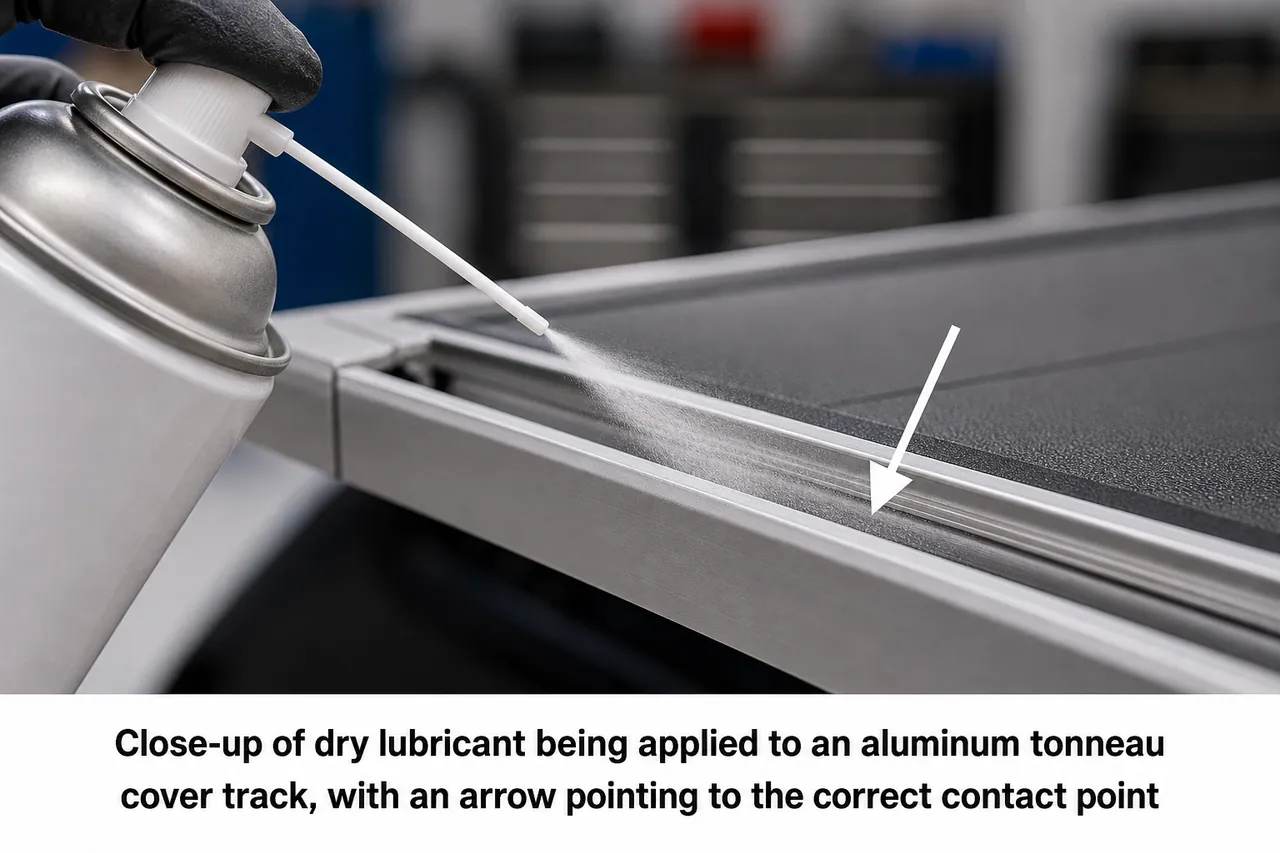
Moving parts want dry lube. Per RealTruck, WD-40 Specialist Dry Lube with PTFE is the right product for hinges and tracks. Here is the mechanism competitors leave out: oil-based sprays attract dust. Per LEER, oil-based lubricants on tracks gather dirt and gum up the rails, and on a retractable that grit-laden oil turns into an abrasive paste in the channel that jams the slats. PTFE goes on wet, dries to a dry film, and leaves nothing for grit to stick to. LEER recommends lubricating hinges and tracks every 3 to 6 months, more often after dusty or off-road use.

Close-up of dry lubricant being applied to an aluminum tonneau cover track, with an arrow pointing to the correct contact point


5. Can You Run a Tonneau Cover Through a Car Wash?

Touch-free only, and decline the spray wax. A touch-free wash uses high-pressure water and no brushes, which is generally safe for any cover. A brush or soft-cloth wash drags abrasive material across the cover and forces water under the seals, so avoid those regardless of cover type. Hand-washing stays the gold standard for seal life.

Touch-free washes

Per RealTruck, touch-free car washes are safe for tonneau covers. The catch is the add-on menu: always decline the spray-wax option. That spray wax builds up on vinyl, canvas, and rubber seals and does none of the good it does on paint.

Brush and soft-cloth automated washes

Skip them. Per RealTruck, the abrasive brushes in these washes destroy stitching and force water under the seals, where it sits and starts the mold problem from Section 6. One pass usually will not destroy a cover, but it is the kind of repeated stress that ages a soft cover fast.

Hand-washing

For seal longevity, nothing beats washing by hand. You control the pressure, you keep water out of the seams, and you catch problems (a lifting seal, a worn Velcro strip) while they are small.

Which wash is safe for your cover

Cover type Touch-free wash Brush / cloth wash Hand wash
Soft vinyl / canvas Caution (decline spray wax) Avoid Best
Hard aluminum / fiberglass Safe (decline spray wax) Avoid Best
Retractable Caution (keep water off rails) Avoid Best

6. How to Remove Mold and Mildew from a Tonneau Cover

White vinegar, one to one with water. Mix equal parts white vinegar and water, apply it to the moldy area, wait 5 minutes, scrub with a soft brush, and rinse thoroughly. Per RealTruck, this solution kills mold and mildew without damaging vinyl. Then dry the cover completely before rolling it up, because the same trapped moisture is what caused it.

Why it shows up

Mold needs two things: moisture and an organic surface to feed on. A soft cover folded up damp, with a little leaf debris or pollen trapped in the folds, gives it both. That is why the drying step in Section 3 is not optional. Fix the mold once and skip the drying, and it comes right back.

How to prevent it

  • Dry the cover fully before folding or rolling, every time.
  • After a wash, park facing the wind for a few minutes to speed the dry.
  • Check the drain channels and the cab-end bulkhead seal, where water and debris collect.

A second prevention habit that gets overlooked: clear the bed itself. Wet leaves, grass clippings, and food wrappers left under a closed cover feed mold from below, so the underside of the cover grows it even when the top looks clean. A quick sweep of the bed before you close up removes the organic food source that the moisture needs.

When it is too far gone

If vinegar will not lift it, move to a dedicated mold cleaner. Convertible-top formulas work on the same coated vinyl, and brands like 303 and RaggTopp make products built for it. After any heavy mold treatment, re-apply your UV protectant, since aggressive cleaning strips the existing layer.


7. How Often Should You Clean and Maintain Your Tonneau Cover?

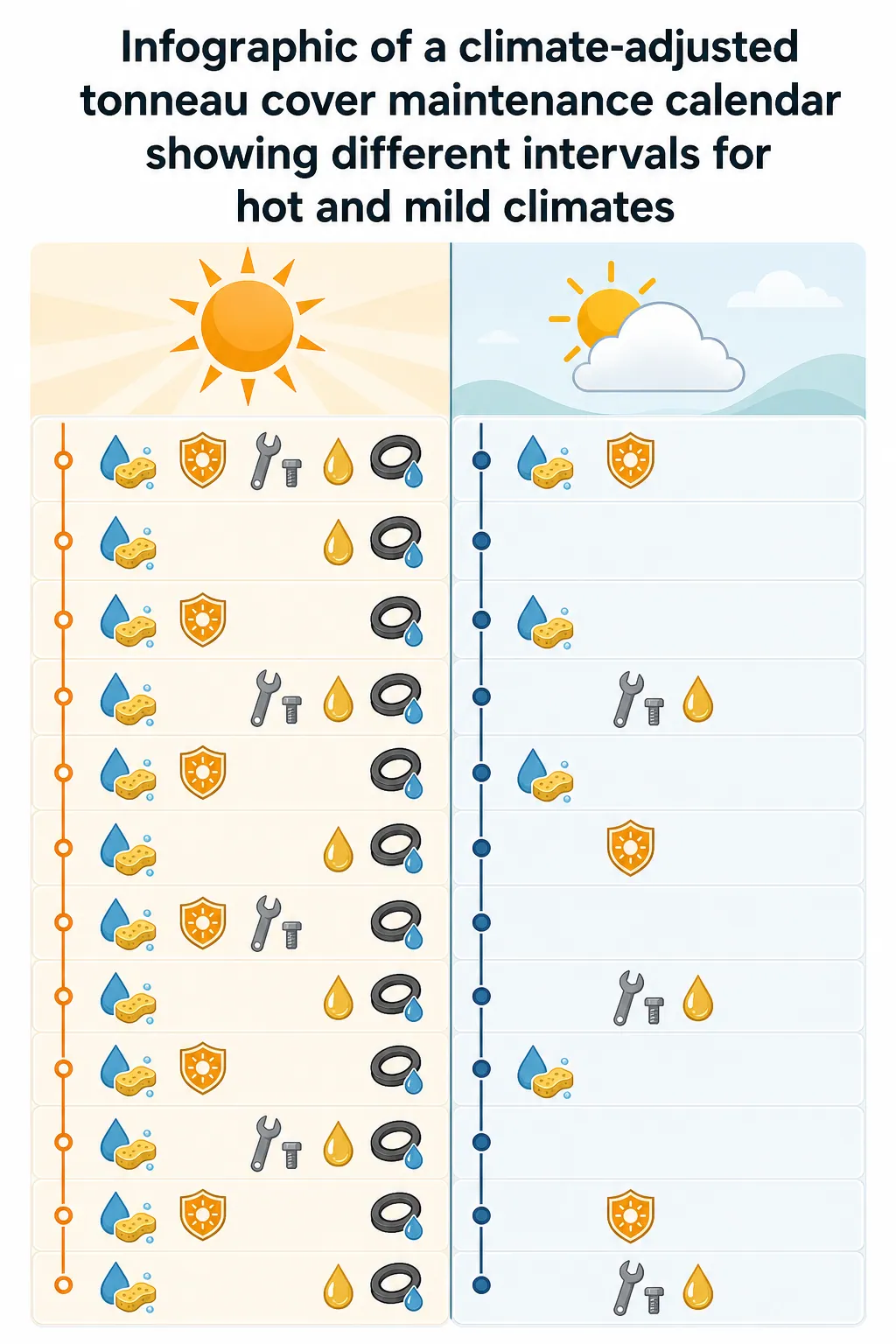
Wash monthly, but maintenance runs on several clocks. A basic wash every month, or after any muddy or dusty trip, keeps the surface healthy. Protectant, hardware checks, lubrication, and seal conditioning each run on their own schedule, and the right interval depends on your climate. Hot, high-UV regions need protectant more than twice as often as mild ones.

This is where a single "every 3 months" rule fails people. An Arizona truck under a UV index of 10-plus for half the year is on a different clock than an Oregon truck under a UV index of 3 to 4. Here is the schedule we run, adjusted for climate.

Task Frequency
Basic wash (soft cover) Monthly, or after muddy or dusty use
Basic wash (hard cover) Monthly, or with the truck wash
UV protectant, hot climates (SW, SE) Every 30 to 45 days
UV protectant, mild or cool climates (PNW, NE) Every 3 months
UV protectant, hard covers 1 to 2 times per year, by sun exposure
Hardware and fastener inspection Every 3,000 to 5,000 miles, or each oil change
Hinge and track lubrication Every 3 to 6 months, or after off-road or dusty use
Rubber seal conditioning Every 3 to 6 months

The intervals come from the manufacturers we follow. Per MyTruckNeedsThis, soft-cover protectant goes on every 30 to 45 days for best UV protection. Per LEER, hard covers need protectant only 1 to 2 times a year depending on sun exposure, mounting hardware should be inspected every 3,000 to 5,000 miles or each oil change, and hinges and tracks want lubrication every 3 to 6 months. RealTruck adds a useful break-in check: re-check the tightness of the mounting hardware after the first 500 miles, then at each oil change after that. Conditioning the rubber seals every 3 to 6 months keeps them from cracking in cold weather.

Infographic of a climate-adjusted tonneau cover maintenance calendar showing different intervals for hot and mild climates


8. Best Tonneau Cover Cleaners and Conditioners

Dedicated tonneau cleaners exist for a reason. Their pH and built-in conditioners are tuned for vinyl and canvas, where a regular car shampoo is not. For soft covers especially, a purpose-built cleaner protects the coating you are trying to keep. Below are the products that show up most in our testing and in owner reviews, grouped by what you have.

Bought, not gifted · No paid placements · at no extra cost to you.

For soft (vinyl and canvas) covers

Per MyTruckNeedsThis review data, these are the top-rated soft-cover products:

  • 303 Convertible Vinyl Top & Tonneau Cover Care Kit (4.5 stars). Cleaner and protectant in one box, built for coated vinyl. The default pick if you want one kit that does both jobs. [Check on Amazon]
  • TruXedo Pro-TeX Protectant Spray (4.4 stars). A quick-application protectant for between-wash UV upkeep. Light on cleaning power, strong on protection. [Check on Amazon]
  • Meguiar's M40 Vinyl Cleaner & Conditioner (4.4 stars). A detailer's vinyl cleaner that doubles on convertible tops. Good for a deeper periodic clean. [Check on Amazon]
  • Extang Tonno Tonic 1181 (4.3 stars). A spray-and-wipe conditioner from a cover maker, easy for fast touch-ups. [Check on Amazon]
  • Wolfsteins Tonneau Cover Care Kit (4.2 stars). A full care kit for owners who want a complete soft-cover system. [Check on Amazon]

For hard covers

  • LEER Tonneau Cleaner. Per its Amazon listing, it is formulated for rubber, vinyl, plastic, fiberglass, and stainless steel, which makes it a one-bottle option for a hard cover plus its seals. [Check on Amazon]
  • Standard automotive wax or sealant for painted fiberglass tops. Skip the wax on a matte aluminum finish, and keep it off the seals on any cover.

For tracks and hinges

  • WD-40 Specialist Dry Lube with PTFE. The dry-film lube RealTruck recommends for hinges and tracks. It is the difference between a smooth-rolling retractable and a grit-jammed one. [Check on Amazon]

Not sure your cover even needs a dedicated cleaner yet? Browse our tested tonneau cover picks to see which covers we actually buy and run, and how much upkeep each one takes.

Product flat-lay of the top three soft-cover cleaners arranged on a truck bed


9. FAQ: Questions We Actually Get

Can I use dish soap on a tonneau cover?

Diluted, pH-neutral dish soap is a last resort for a soft cover, not a routine cleaner. It works in a pinch, but most dish soaps are degreasers, and used regularly they strip the factory coating that protects the vinyl. For anything beyond a one-off, use a pH-neutral car shampoo or a dedicated tonneau cleaner instead.

My tonneau cover Velcro won't stick anymore. Did I ruin it?

Probably not. Most of the time the hooks are just packed with grit and lint. Blow the strip out with compressed air or work a soft brush along the direction of the hooks, and the grip usually comes back. If the plastic hooks themselves are worn flat, the Velcro strips on most soft covers are replaceable, so it is a cheap fix rather than a new cover.

Will cleaning void my warranty?

It can, if you use the wrong product. Per MyTruckNeedsThis, petroleum-based and silicone products like Armor All damage vinyl and may void the manufacturer warranty. Brands including LEER and TruXedo spell out in their fine print that unauthorized cleaners void coverage. Stick to pH-neutral or dedicated tonneau products on soft covers and you are clear.

Can I wax a hard tonneau cover?

Yes for painted fiberglass. No for matte aluminum, where wax leaves a sheen and streaks the flat finish. Either way, keep wax off the rubber seals and the hinges, because it dries the seals out and keeps them from sealing flush. Wax the painted top surface only.

How do I clean a BakFlip tonneau cover?

BakFlip MX4 and G2 covers are matte aluminum, so treat them as hard covers with a matte finish. Wash with mild car shampoo and a soft mitt, skip the wax entirely to protect the matte look, keep cleaners off the seals, and hit the hinges with PTFE dry lube. No Armor All or petroleum sprays needed anywhere on it.

Close-up of a tonneau cover Velcro strip clogged with debris being cleaned with compressed air

Photo by Frank Nothdurft on Unsplash


10. Final Checklist: Keep It Looking Good for 5+ Years

We install these covers ourselves, and the ones that still look new after years follow the same short rulebook. Run this list and the rest takes care of itself.

  1. Identify your material before you buy any product.
  2. Keep two kits: pH-neutral for soft, standard shampoo for hard.
  3. Never put Armor All, silicone, or petroleum sprays on a soft cover.
  4. Rinse loose grit before any brush touches the surface.
  5. Pre-treat stains, and clean the Velcro along the hooks, not across them.
  6. Rinse until the water runs clear, then dry fully before folding.
  7. Use a fan nozzle and 18 inches of distance if you pressure wash.
  8. Touch-free car washes only, and always decline the spray wax.
  9. Protect on a climate clock: every 30 to 45 days in hot sun, every 3 months in mild weather.
  10. Dry lube the hinges and tracks, never oil, and condition the seals twice a year.

Picking a cover for a specific truck and want to know how much upkeep it brings? Start with covers by truck make and model and match the maintenance to how you actually use the bed.

Editorial team · TruckBedCoverFinder · Bought, not gifted · No paid placements

Keep reading

Related stories

Find my cover